Revolutionary Movements in Modernization
February 18th, 2016
Ornamentation and Crime by Adolf LoosThe Founding and Manifesto of Futurism by F.T. Marinetti

Lecture by Riyaz Tayyibji
Beginning of the twentieth century saw the birth of
modernism. Modern philosophers believed the traditional orders of art,
architecture, literature, society and religion to be obsolete in the light of
the new ideas on economic, political and social conditions of the emerging
industrialized world. Simplified forms and diminishing of ornament largely
characterized modern architecture in sync with the rapid technological
advancement and the transformation of society.
Adolf Loos, a
young architect in Vienna became known for the radical statements he made
reproving ornamentation. In his revolutionary essay, ‘Ornament and Crime’ in 1908, he explored the idea
that the progress of culture is associated with the
deletion of ornament from everyday objects. According to him, the modern
age people had evolved to a point where they didn’t need to submit themselves
to primitive adornment that used to be the need for some cultures in the
historic age. That it
was therefore a crime to impose craftsmen and builders to squander their time
on ornamentation that served to hasten the
time when an object would become outdated. Loos spoke of the social cost of
ornamentation and felt that ornament belonged to the rich imperial class and
was not essential in the functionality of the object. Thus it could be done
away with to hasten the process of mass production. As an object evolves, it
becomes simpler and cheaper. Bicycle and pencil are the emblems of simplicity. Loos
attacked contemporary design as well as the imitative styling of the nineteenth
century. He looked on contemporary decoration as mass-produced,
mass-consumed trash. He asserted that for a culture to evolve the removal of
ornamentation from functional objects was necessary.
Loos acted as a
model and a seer for architects of the early
twentieth century. His fight for freedom from the decorative styles of the
nineteenth century led a campaign for future
architects. Around the same time in 1909, in Sicily, Italy, F. T. Marinetti
along with other young revolutionary ‘Futurist’ thinkers wrote the volatile article
‘The Founding and
Manifesto of Futurism’ in the Le Figaro, Paris. The manifesto became a
foundation document for a new artistic movement, which called for a dismissal
of the past and the celebration of innovation and aggressive action as the
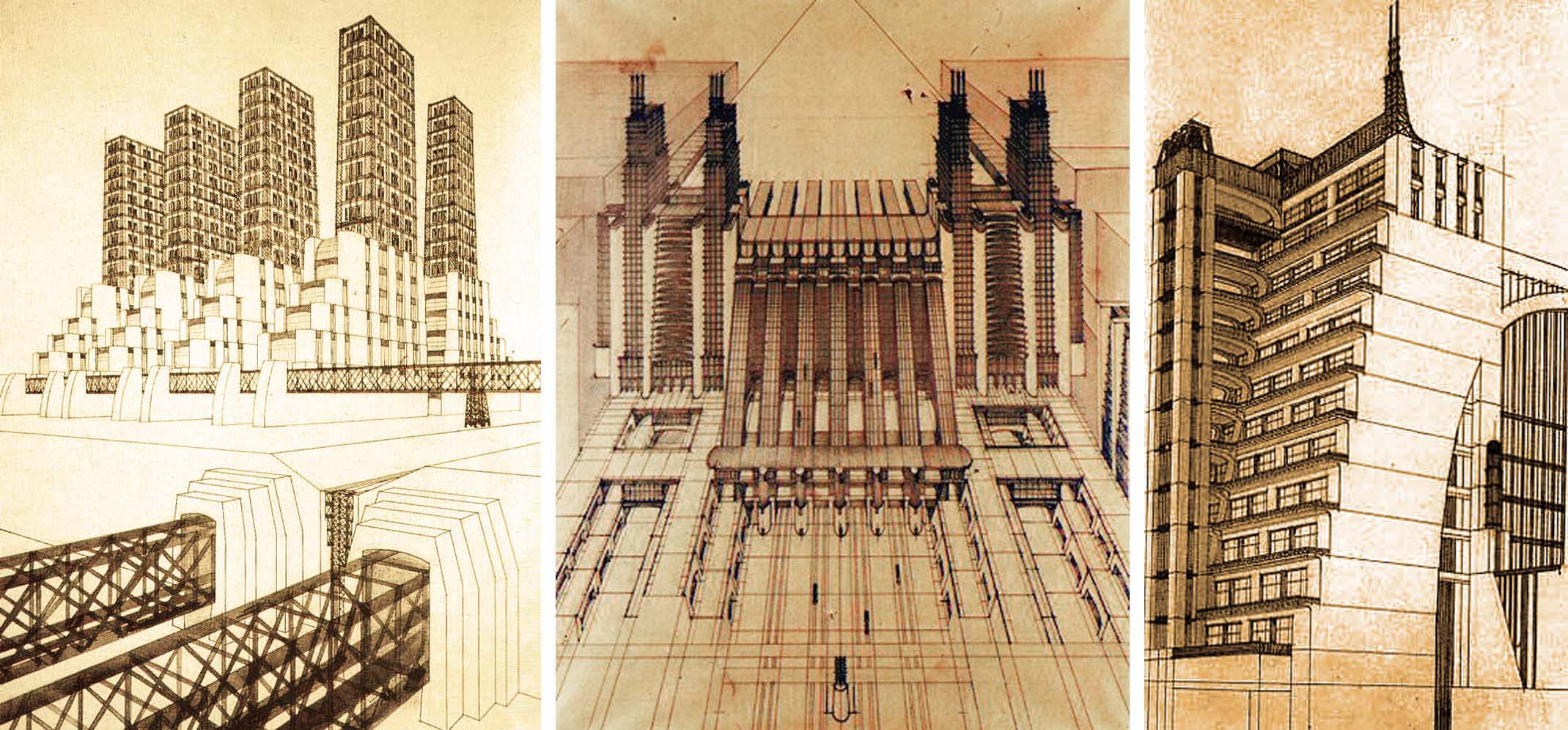
fiery writing glorified technological progress and industrialization. Antonio Sant’Elia, a builder by training published a manifesto
Futurist Architecture in 1914, where is stated that “the decorative value of Futurist
architecture depends solely on the use and original arrangement of raw or
bare or violently colored materials”. He had a vision of a highly
mechanized city with towering skyscrapers, magnificent bridges and aerial
walkways that exalted modern technology.
That time was of revolutionary thoughts, the fire in their
belly, the fight to make a change, of speed and of innovation. A moment when
time stood still, as the young and the agitated spoke up to make a difference,
a monumental time in the history of modernization.


Comments
Post a Comment