Legacies of Indian Modern Architecture
March 3rd, 2016
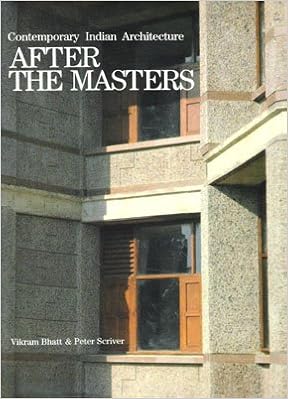
After the Master by Vikram Bhatt & Peter Scriver
Lecture by Dr. Gauri Bharat
Written in the year 1990, After the Masters by Vikram
Bhatt and Peter Scriver discusses the identity of contemporary Indian
architecture that emerged in the mid twentieth century. The book is structured
in five segments: India- Problems & Prospects, Roots & Modernity,
Alternatives for a Developing India, Architect & the Marketplace and
Emerging Architecture. Each segment is illustrated with several architectural
projects in India, dominated largely by works in Ahmedabad and New Delhi, due
to the authors’ familiarity with these two cities.
The text talks about how effectively the Modernist
ideology tries to achieve an appropriate self-conscious, regionalist
expression. The book is written with a euro-centric audience in mind and portrays
the modernity existing outside Europe as the ‘other’ modernity, the ones who
don’t have trajectories or a detailed past. How do we then, look at regional
modernity? How do we develop a native framework to understand architecture as a
discipline?
The first two decades post independence saw a colonial
beginning of the architectural profession in India and was marked by catalytic
Modernist projects of Western masters, Le Corbusier and Louis Kahn and their
legacies that shaped Indian architecture. Alongside, vernacular architecture of
India brought about the ‘Indianness’ in contemporary architectural production. Much
of postmodern architecture was built in Corbusierean aesthetics, marrying it to
climatic conditions.
The book sites India as a ‘developing country’ that has
its economic and technocratic limitations. The building industry is typically
labour-intensive as opposed to the developed nations. This technical
backwardness can be looked as an opportunity in architectural inventions than a
hindrance. Modernist aspirations
exist in spite of these challenges and become a constant source of inspiration
to the architects of this recently emerging independent nation. The skilled
craftsmanship and high quality materials are historical and ritualistic links
of the rich heritage to contemporary architectural production. It is
interesting to note that the text discusses the role of an architect in a
‘developing country’ as not merely that of producing iconic institutional
buildings but that the architect responds to the need of the growing middle
class and acts as an agent of social change to take up more socially relevant
projects. The contemporary Indian architect reacts to the market and as
inappropriate as it may sound, he follows the law of demand and supply to delve
into commercial and corporate architecture. In the rapidly urbanizing India,
the Government remains the major client for the construction industry. As
practiced in the colonial times these numerous public amenities were undertaken
by the Public Works Department that consisted of only engineers who built
structurally sound repetitive architecture, limiting a larger impact of the
architects in the Indian scene. This practice is gradually changing by
collaborations of the PWD with architects.
The book has a rhizomatic approach of global architecture.
The narrative consistently focuses on the backwardness of a developing nation
in relation to the western developed countries and belittles its modernity.
While many architectural projects are discussed at length in the various
segments, the imagined standard of the third world country architecture doesn’t
allow the authors to fully appreciate any of the works. The authors briefly
touch upon the influences that Indian projects had on Corbusier’s parallel
works, but have not fully explored the idea. The text leaves one with an itch
to investigate the idea of Indian modernity and to explore the idea of parallel
multiple modernities.
(Word count: 561)


Comments
Post a Comment